
Gas Test Pressure Gauge 60 Pound
4.3Editor score
Forged Steel Body
Dual Scale Readings
Easy To Read Dial
Selecting the right Gas Line Pressure Gauge is essential for ensuring safety and efficiency in any gas system installation or maintenance project. Whether you are a professional plumber or a DIY enthusiast, accurate pressure readings prevent leaks and ensure appliances operate within safe limits.
We evaluated ten leading models based on durability, accuracy, ease of use, and compatibility with various gas line configurations. Our analysis focuses on key specifications such as connection types, pressure ranges, and material quality to help you make an informed decision.
Each pick below highlights specific strengths and ideal use cases to guide your selection process effectively. Please note that availability and specific details may change over time, so always verify current specifications before purchasing any tool.
4.3Editor score
4.5Editor score

4.7Editor score
As an Amazon Associate we earn from qualifying purchases.
The following table provides a side-by-side comparison of all ten selected Gas Line Pressure Gauge models to highlight their unique specifications and capabilities at a glance.


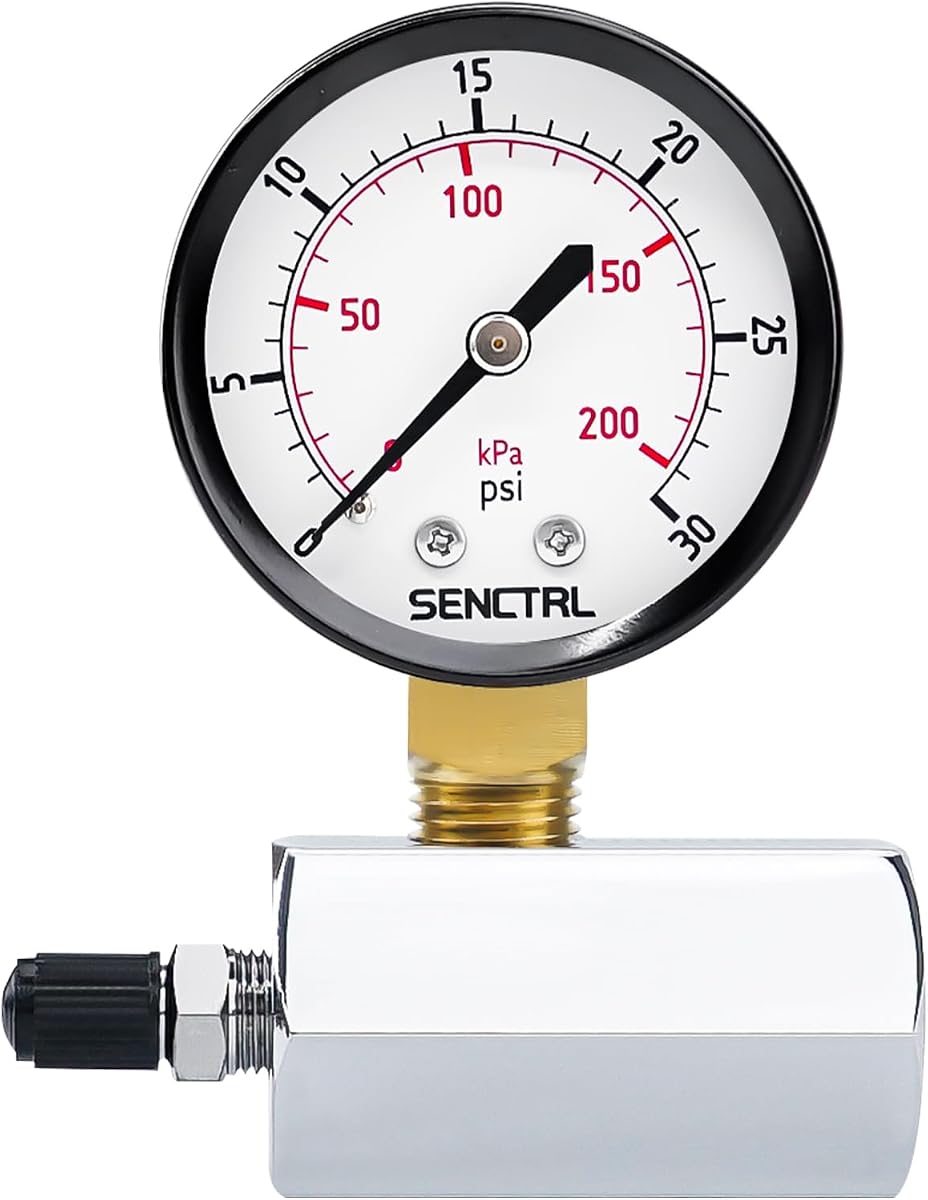
This pressure test gauge is designed for measuring gas line or tank pressure with high reliability. Its solid assembly includes a 2 inch gauge and a chrome plated steel body that resists corrosion effectively.
We may earn a commission when you buy through this link, at no additional cost to you.
The dual scale display allows users to read measurements in both PSI and kPa, making it versatile for different standards. The black steel case protects the internal components while maintaining a professional appearance.
While the accuracy is good for most residential tasks, the range is limited to 30 PSI which might not suit high pressure applications. The connection type is fixed which requires specific line compatibility.
This gauge is ideal for homeowners and professionals needing a reliable tool for standard natural gas lines. Its balance of quality and functionality makes it a top recommendation for general testing needs.
The gauge offers accurate readings within a 3/2/3% margin ensuring confidence during critical safety checks.
Constructed with chrome plated steel and a black steel case it withstands harsh environments without rusting.
We may earn a commission when you buy through this link, at no additional cost to you.
This natural gas pressure tester features a forged brass cup-shaped construction that ensures long-lasting durability. It is designed to connect easily to household gas lines for accurate leak detection.
We may earn a commission when you buy through this link, at no additional cost to you.
The transparent steel air pressure gauge improves reliability and readability. Dual scale markings in bar and psi make it accessible for users from different regions or backgrounds.
Proper installation requires wrapping PTFE tape and tightening parts to avoid leaks. It is best suited for underground or indoor gas lines where corrosion resistance is vital.
Ideal for technicians and DIYers checking gas or air pressure in tubes. Its robust build and compliance with industry standards make it a trustworthy choice for critical inspections.
Forged brass provides excellent corrosion resistance extending the life of the measuring device significantly.
Widely used to measure gas or air pressure in various tubes without obstructing connection ports.
We may earn a commission when you buy through this link, at no additional cost to you.
This assembly offers a 60 PSI range suitable for more demanding gas line tests. It includes a brass valve and a sturdy steel case for enhanced protection during use.
We may earn a commission when you buy through this link, at no additional cost to you.
The 2 inch pressure gauge is designed for easy reading with a non-fading glass lens. Dual scale options in PSI and kPa provide flexibility for international standards.
While it has a simple design, the burdon tube type ensures reliable mechanical measurement. The weight of the steel body adds to durability but might be less portable.
Recommended for users needing higher pressure capacity without spending much. Its combination of strength and affordability makes it a solid budget choice for various testing scenarios.
With a 60 PSI range it handles higher pressures than standard low-pressure gauges effectively.
The durable glass lens prevents fading ensuring long-term readability in various lighting conditions.
We may earn a commission when you buy through this link, at no additional cost to you.
Designed for pressure testing on gas lines, this assembly features a 2-1/2 inch dial for better visibility. Brass wetted parts ensure compatibility with various gas types.
We may earn a commission when you buy through this link, at no additional cost to you.
The black steel case and dry design protect the internal mechanism from moisture. Direct connection via 3/4 NPT female thread simplifies attachment to lines.
Accuracy is within +/-3-2-3% which is standard for this class. While it lacks a hose the direct connection is efficient for close-proximity testing.
Best for professionals needing a robust assembly for regular maintenance. Its focus on material quality and dial size ensures consistent performance over time.
The 2-1/2 inch dial size provides excellent visibility for quick and easy reading during tests.
Brass wetted parts prevent corrosion when in contact with natural gas or other fuels.
We may earn a commission when you buy through this link, at no additional cost to you.
This kit helps identify low fuel pressure issues and faulty regulators. It features a double scale gauge with a 100 PSI range for versatile engine diagnostics.
We may earn a commission when you buy through this link, at no additional cost to you.
Three size adapters cover common fuel line dimensions. High quality brass connectors and rubber hoses resist corrosion and last long in demanding environments.
The universal design works on any engine requiring PSI readings. However it is not suitable for diesel engines so users must verify compatibility before use.
Ideal for mechanics and car owners needing to diagnose fuel systems. Its comprehensive kit approach saves time compared to buying individual components.
Three size adapters ensure compatibility with most common fuel line configurations for ease of use.
Effectively identifies leaking injectors and clogged filters to streamline troubleshooting procedures.
We may earn a commission when you buy through this link, at no additional cost to you.
Designed for measuring low pressure across appliance manifolds this kit includes a 40 inch hose for reach. It features a beryllium diaphragm capsule for precision.
We may earn a commission when you buy through this link, at no additional cost to you.
The 2-1/2 inch dial offers clear readings in W.C. and ounces per square inch. It fits into a molded plastic box for storage and protection.
Accuracy is within +/-3-2-3% ensuring reliable data for natural gas and LP gas. The specific pressure range limits it to low pressure systems.
Perfect for technicians servicing gas appliances. The long hose and protective case make it convenient for field work and organized storage.
The 40 inch rubber hose allows access to hard-to-reach manifolds without moving appliances.
The beryllium diaphragm capsule ensures consistent and accurate readings for sensitive gas systems.
We may earn a commission when you buy through this link, at no additional cost to you.
This gauge tests gas pressure in tanks up to 15 psi with 1/10th increments. It features a durable plastic face and chrome plated body for safety.
We may earn a commission when you buy through this link, at no additional cost to you.
The clear facing helps see pressure measurements with ease. It is designed to fit onto 3/4 inch MPT threads for direct tank connection.
While the increments are precise the low max pressure restricts it to small tanks. The steel case adds protection against physical impact during transport.
Best for checking tank pressure for propane or natural gas systems. Its incremental precision makes it valuable for fine-tuning pressure levels accurately.
The 1/10th increments allow for very precise adjustments and readings on low pressure systems.
Chrome plated body and steel case ensure resistance to wear and tear in workshop environments.
We may earn a commission when you buy through this link, at no additional cost to you.
This kit includes a 40 inch hose and barbed connections for flexibility in various scenarios. It supports quick connect fittings including hex bushings for solid connections.
We may earn a commission when you buy through this link, at no additional cost to you.
The zero adjustable setting allows for calibration to ensure accuracy. The temperature range is suitable for standard indoor and outdoor gas testing conditions.
While the thread size is nominal and not actual diameter it provides broad compatibility. The longer distance meets needs for different scenarios like complex manifolds.
Recommended for professionals needing flexible setup options. Its high rating and feature set justify the investment for advanced gas pressure testing tasks.
The 40 inch hose and barbed connections provide freedom to reach complex manifold setups easily.
Zero adjustable settings ensure readings are accurate and reliable across different testing conditions.
We may earn a commission when you buy through this link, at no additional cost to you.
This inline fuel pressure gauge is glycerin-filled to provide accurate and stable readings. It includes 3/8 and 5/16 brass barb fittings for various configurations.
We may earn a commission when you buy through this link, at no additional cost to you.
The center back mount installation provides accessibility and visibility while in operation. High-quality stainless steel and brass ensure durability against corrosion.
While designed for fuel systems it is excellent for automotive marine and industrial applications. The low pressure range limits it to specific fuel system needs.
Ideal for monitoring performance during tuning or diagnostics. Its durable construction and easy installation make it a practical tool for vehicle maintenance.
Glycerin filling dampens vibrations ensuring smooth and stable needle movement for accurate data.
High-quality stainless steel and brass resist corrosion in demanding fuel environments effectively.
We may earn a commission when you buy through this link, at no additional cost to you.
This kit quickly locates malfunctioning fuel system components without removing them from the vehicle. It features a large easy to read gauge with impact resistant housing.
We may earn a commission when you buy through this link, at no additional cost to you.
High quality solid brass fittings and tubing ensure long lasting performance. A convenient pressure relief valve allows for safe clean testing procedures.
The 0-100 psi range covers most automotive needs. While it costs more it delivers professional reliability for critical diagnostics in repair shops.
Recommended for professional mechanics needing a dependable solution. Its focus on safety and durability makes it a standard choice for serious applications.
The pressure relief valve allows for safe clean testing without releasing hazardous fuel unexpectedly.
Solid brass fittings and tubing ensure consistent performance even with daily professional use.
We may earn a commission when you buy through this link, at no additional cost to you.
Selecting the right Gas Line Pressure Gauge requires understanding your specific needs and the system requirements to ensure safety and accuracy.
Always choose a gauge with a range that exceeds your expected system pressure to prevent damage and ensure accuracy. For natural gas lines typical ranges are between 0 to 30 PSI but industrial systems may require higher limits.
Select a gauge that matches the maximum pressure of your system to avoid reading errors or mechanical failure during operation.
Verify that the thread type such as NPT matches your gas line connections to ensure a secure fit. Using the wrong thread can lead to leaks or damage to the system components.
Check the inlet size and thread style carefully to guarantee compatibility with your specific gas line setup.
Look for materials like brass or chrome plated steel that resist corrosion since gas environments can be harsh. High quality materials extend the life of the gauge and ensure consistent performance over time.
Prioritize corrosion resistant materials to maintain accuracy and durability in varying weather and environmental conditions.
A clear and large dial face allows for quick readings which is critical during maintenance or safety checks. Ensure the scale markings are legible and the needle moves smoothly without sticking.
Choose a gauge with a high contrast face to improve readability in low light or outdoor environments.
Accuracy is typically expressed as a percentage of full scale. For safety critical applications look for ratings within +/-3 to 5 percent to ensure precise measurements.
Higher accuracy ratings reduce the risk of misdiagnosis when checking for leaks or pressure drops.
Some kits include hoses or extra fittings which can save time and money. Consider if you need flexible connections for hard to reach areas or if a direct gauge is sufficient.
Verify the length and material of any included hoses to ensure they meet your installation requirements.
Gauges with pressure relief valves or protective cases add an extra layer of safety for the user. These features prevent over pressurization and physical damage to the instrument.
Always check for safety standards compliance to ensure the gauge is safe for professional or residential use.
Established brands often provide better quality control and customer support. Researching reviews and brand history can help avoid defective products that might fail during critical use.
Choose reputable manufacturers with a track record of reliable pressure measurement tools.
Before connecting the gauge to a gas line always ensure the system is depressurized to prevent injury or damage. Wrap PTFE tape on all threads to create a tight seal and avoid leaks during the test.
Once connected open the valve slowly to allow pressure to enter the gauge. Observe the reading carefully and ensure the needle stabilizes before recording any data for accuracy.
After use close the valve immediately and disconnect the gauge from the system. Store it in a dry and protective case to prevent physical damage and corrosion in humid conditions.
Residential natural gas lines typically operate at low pressures ranging from 0 to 30 PSI. Most home appliances require pressure within this range to function safely and efficiently. Always verify the specific requirements of your local utility provider before testing.
No you should never use a water pressure gauge for gas line testing. Gas gauges are designed with different safety standards and materials to prevent leaks and corrosion from fuel. Using the wrong type of gauge can lead to dangerous situations and inaccurate results.
It is recommended to calibrate your gauge at least once a year or after it is dropped or subjected to shock. Regular calibration ensures that readings remain accurate and reliable for safety checks. Some manufacturers provide specific calibration schedules that should be followed.
Needle fluctuation can be caused by pulsating pressure in the system or air bubbles trapped in the gauge. Using a glycerin filled gauge can help dampen these vibrations for a stable reading. Ensure all connections are tight to prevent intermittent leaks.
PSI stands for pounds per square inch while kPa is kilopascals a metric unit of pressure. Both units measure the same physical property but use different numerical scales. Most modern gauges offer a dual scale to accommodate both measurement systems.
It depends on the setup and the location of the test point. Some gauges connect directly to the line while others require a flexible hose to reach difficult areas. Always check the connection type required by your specific appliance or valve.
We have reviewed ten top options ranging from budget friendly models to professional grade kits for various needs. Each pick offers distinct advantages whether you need precision for low pressure systems or durability for heavy use.
When making your decision prioritize factors such as connection type accuracy and material quality to ensure safety and reliability. Select a gauge that fits your specific application requirements to avoid unnecessary complications.
Always check current availability and verify the latest product details before buying to ensure compatibility with your system. Choosing the right tool helps you maintain gas systems safely and effectively for years to come.