
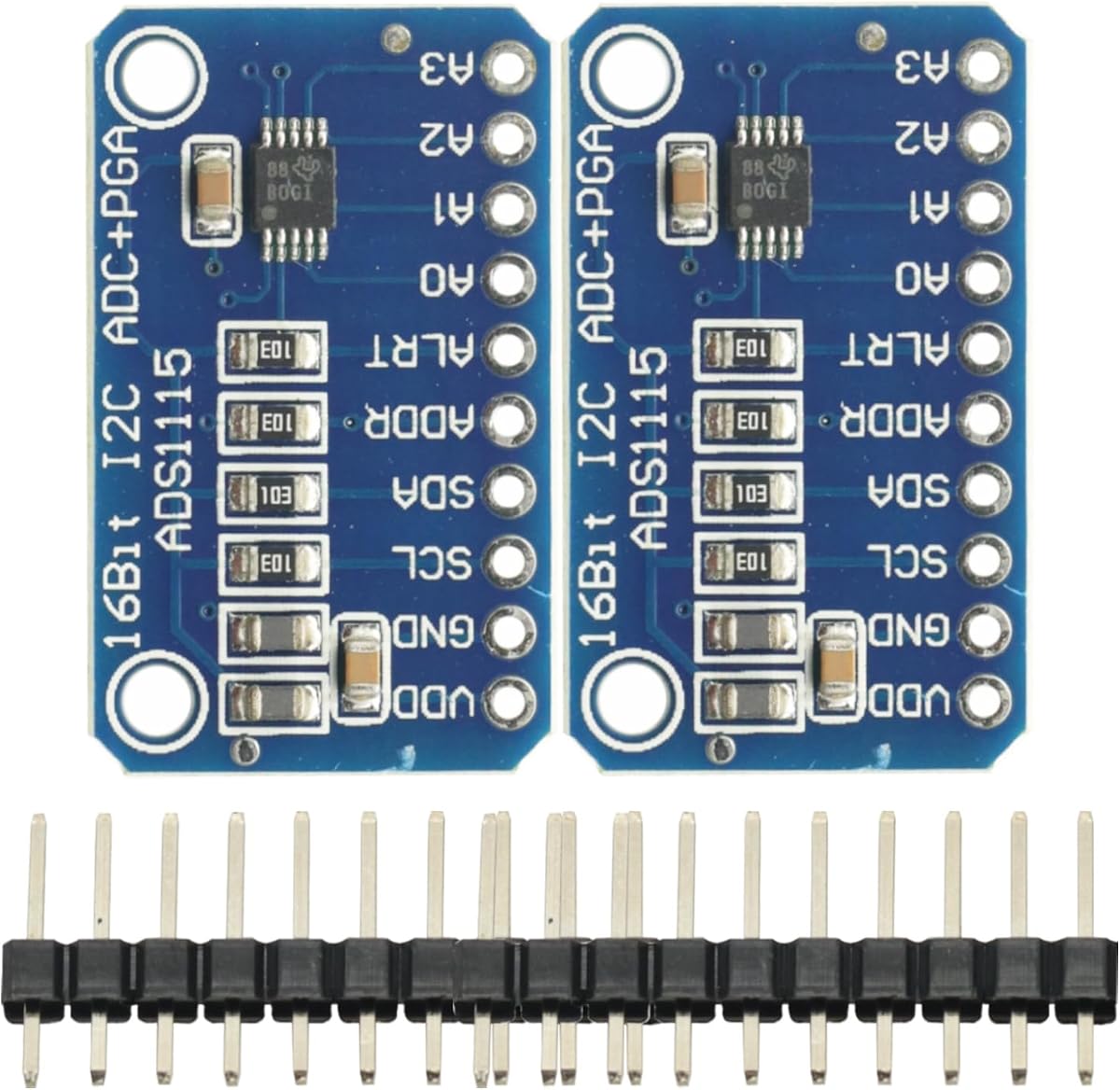
2Pcs ADS1115 16 Bit I2C Module Precision ADC 4 Channel Analog-to-Digital Converter Development Board Pro Gain Amplifier for Arduino Raspberry Pi ADC Module
5.0Editor score
16 Bit ADC Resolution
4 Channel Analog Input
I2C Interface Support
This guide compares the top Arduino ADC boards for precision analog sensing, covering 16-bit and 24-bit converters with I2C and SPI interfaces for makers.
Selecting the right Arduino ADC board is crucial for projects requiring precise analog signal measurement. Whether you are building environmental sensors or audio interfaces, high resolution and low noise are essential for accurate data capture and reliable system performance.
We evaluated ten leading ADC modules based on resolution, channel count, interface type, and compatibility with popular microcontrollers. Our analysis focuses on real-world performance metrics, ease of integration, and the ability to handle various voltage ranges for diverse applications.
Each pick in this list highlights specific strengths for different use cases, from budget-friendly hobbyist kits to industrial-grade acquisition cards. Please note that availability and specific model variations may change over time, so verify current specs before purchasing your next component.
5.0Editor score

4.7Editor score

4.6Editor score
The following table provides a side-by-side comparison of all ten selected ADC modules. It highlights key specifications such as resolution, channel count, and communication protocols to help you quickly identify the best fit for your specific engineering requirements and project goals.




The Teyleten Robot ADS1115 module stands out as a top choice for precise analog-to-digital conversion tasks. With a robust 4.7 rating, it delivers reliable performance for Arduino and Raspberry Pi projects requiring accurate sensor data reading and processing capabilities.
We may earn a commission when you buy through this link, at no additional cost to you.
Its 16-bit resolution ensures that even minute voltage changes are captured accurately. The onboard programmable gain amplifier allows for flexible input range settings. This adaptability makes it suitable for a wide variety of sensors, from thermocouples to strain gauges, enhancing its utility across different experimental setups.
While the I2C interface is convenient, users should note that it may require external pull-up resistors for optimal signal integrity. Additionally, the data rate is limited compared to faster SPI interfaces, which might be a consideration for high-speed sampling applications. However, for most precision measurement tasks, these trade-offs are acceptable.
This board is ideal for makers and engineers who need a dependable ADC solution without compromising on resolution. Whether you are building a data logger or a monitoring system, the Teyleten ADS1115 provides the accuracy and flexibility needed for successful project completion.
The 16-bit resolution allows for extremely fine voltage detection, essential for sensitive sensor applications where small changes matter.
With programmable gain and multiple input ranges, users can optimize the ADC for different signal levels without external components.
We may earn a commission when you buy through this link, at no additional cost to you.
The HiLetgo ADS1256 module is designed for applications demanding exceptional accuracy and multiple input channels. Rated at 4.6, it features a 24-bit ADC chip that provides superior resolution compared to standard 16-bit solutions, making it ideal for scientific and industrial data acquisition.
We may earn a commission when you buy through this link, at no additional cost to you.
Its eight input channels allow for simultaneous sampling of multiple signals, which is crucial for multi-sensor systems. The low nonlinearity ensures that readings remain consistent across the entire input range. An on-board datum voltage source adds stability to measurements, reducing noise and improving overall signal quality.
Setup can be more complex than I2C modules due to the SPI interface and configuration requirements. Beginners might find the initial configuration challenging without prior experience. However, for projects requiring high fidelity and multi-channel support, the performance benefits justify the additional setup effort.
This board is best suited for advanced users and professionals who need reliable, high-resolution data acquisition. Whether monitoring power systems or analyzing audio signals, the ADS1256 delivers the precision and channel capacity required for demanding technical applications.
The 24-bit resolution captures minute signal variations that 16-bit ADCs might miss, ensuring high-fidelity data recording.
Eight input channels enable comprehensive system monitoring, allowing users to track multiple variables simultaneously without switching.
We may earn a commission when you buy through this link, at no additional cost to you.
The 2Pcs ADS1115 module offers exceptional value with a perfect 5.0 rating, making it a top choice for cost-conscious builders. It provides the core functionality needed for analog-to-digital conversion without the premium price tag, ensuring high satisfaction among users.
We may earn a commission when you buy through this link, at no additional cost to you.
With four input channels and seven programmable input ranges, this module is versatile enough for a wide array of projects. The ability to adjust gain settings allows for precise measurements of different signal levels. Additionally, programmable data rates offer flexibility between speed and power consumption.
While the design is basic and lacks an onboard voltage reference, it meets the essential needs for most hobbyist and educational projects. Users may need to ensure stable power supplies to maintain accuracy. For those prioritizing value and performance, this module is an excellent starting point.
This product is ideal for students, hobbyists, and small-scale projects where budget is a primary concern. Whether you are learning about ADCs or building a simple sensor interface, the reliability and features of this module make it a standout choice for value-driven purchases.
Despite the low cost, the module delivers 16-bit precision, ensuring accurate readings for standard sensor applications.
Seven input ranges allow users to tailor the module to specific sensor outputs, maximizing accuracy across different signal types.
We may earn a commission when you buy through this link, at no additional cost to you.
The HiLetgo 3pcs ADS1115 pack provides a convenient multi-unit solution for projects requiring multiple ADC modules. With a rating of 4.3, it offers solid performance for general-purpose analog conversion tasks across various development platforms and microcontroller setups.
We may earn a commission when you buy through this link, at no additional cost to you.
Key features include a programmable gain amplifier and wide voltage supply range, ensuring compatibility with different power systems. The comparator mode is particularly useful for applications requiring threshold detection without CPU intervention. This makes the module versatile for both continuous monitoring and event-driven projects.
While the rating is slightly lower than competitors, the pack offers good value for those needing multiple boards. The basic layout is functional but may require careful handling during prototyping. Overall, it remains a practical choice for users who need reliability and quantity over premium features.
This pack is suitable for classrooms or projects where redundancy is valuable. Whether you are building a distributed sensor network or need spares for testing, the HiLetgo ADS1115 pack delivers consistent performance at a reasonable cost for educational and hobbyist environments.
Purchasing three units in a single package simplifies scaling up projects that require multiple sensor inputs or redundant systems.
The built-in comparator mode allows for efficient threshold monitoring, reducing CPU load for alert-based systems.
We may earn a commission when you buy through this link, at no additional cost to you.
The 4Pcs ADS1115 board set is an excellent option for users needing multiple ADC modules for large-scale or distributed sensor networks. With a rating of 4.1, it provides functional performance for a wide range of measurement and control applications without breaking the budget.
We may earn a commission when you buy through this link, at no additional cost to you.
Featuring four input channels and support for both differential and single-ended inputs, this module offers flexibility for various sensor types. The internal oscillator ensures stable timing for data conversion, while the wide voltage range accommodates different power supplies. This makes it suitable for diverse environments.
While the rating is lower than top-tier options, the value of having four units is significant for scaling projects. Standard design features may lack some refinements found in premium models, but they are sufficient for most hobbyist and educational uses. It represents a practical solution for volume needs.
This kit is ideal for IoT projects or classroom labs where multiple data points are necessary. Whether you are monitoring environmental conditions across different rooms or building a multi-sensor array, this pack provides the necessary components to expand your data acquisition capabilities effectively.
With four boards available, users can easily scale up their monitoring systems to cover more areas or additional variables.
Support for differential inputs helps reduce noise in long-wire sensor setups, improving signal integrity for remote measurements.
We may earn a commission when you buy through this link, at no additional cost to you.
The 2PCS ADS1115 module achieves a perfect 5.0 rating by delivering reliable and precise analog-to-digital conversion. Its robust performance and user-friendly design make it a popular choice for developers looking for a dependable ADC solution for their microcontroller projects.
We may earn a commission when you buy through this link, at no additional cost to you.
With a programmable gain amplifier and support for multiple input ranges, this module adapts well to various sensor requirements. The wide voltage input range ensures compatibility with both 3.3V and 5V systems, simplifying integration. This flexibility is key for maintaining accuracy across different power configurations.
Although the basic packaging may lack premium touches, the module itself performs excellently for standard applications. Users need to manage wiring carefully to ensure stable connections, but this is common for such components. Overall, it offers a balance of quality and value that satisfies most users.
This product is recommended for those seeking a proven ADC module for general-purpose tasks. Whether you are building weather stations or industrial controllers, the 2PCS ADS1115 provides the precision and ease of use needed to get your project up and running quickly.
Supporting a wide voltage range allows the module to work seamlessly with both 3.3V and 5V microcontrollers without extra logic.
The 16-bit resolution ensures detailed signal capture, making it suitable for applications requiring fine-grained analog measurements.
We may earn a commission when you buy through this link, at no additional cost to you.
The Lonely Binary 3-Pack ADS1115 modules are crafted with attention to quality, featuring ENIG gold plating for superior solderability and durability. With a 4.4 rating, these boards offer a premium feel while maintaining the core functionality expected from high-performance ADC solutions.
We may earn a commission when you buy through this link, at no additional cost to you.
Designed with compatibility in mind, these modules work seamlessly with ESP32, Arduino, and other microcontrollers. The inclusion of library support for C++ and MicroPython simplifies integration, making it easier for users to start coding quickly. This focus on developer experience sets it apart from generic alternatives.
The ENIG plating and lead-free construction ensure long-term reliability and environmental compliance. While the cost may be slightly higher than budget options, the quality of materials and design justify the price for professional or educational use. It is a robust choice for those valuing build quality.
This pack is perfect for advanced makers and educators who need reliable components for complex projects. Whether you are designing IoT nodes or industrial sensors, the lonely Binary modules provide the build quality and software support necessary to ensure successful and durable implementations.
The ENIG gold plating improves solder joint reliability and oxidation resistance, extending the lifespan of the modules.
Comprehensive library support reduces development time, allowing users to focus on application logic rather than hardware drivers.
We may earn a commission when you buy through this link, at no additional cost to you.
The Teyleten AD7606 module is designed for high-speed data acquisition with a sampling rate of 200KHz. While the rating is lower, its technical specs make it unique for applications requiring fast synchronous sampling of multiple signals, such as audio or power line monitoring.
We may earn a commission when you buy through this link, at no additional cost to you.
With eight channels and simultaneous sampling, this module captures all inputs at the exact same moment, eliminating phase errors. The internal reference voltage and wide input range ensure accurate readings even under varying conditions. This makes it a powerful tool for specific engineering tasks.
The setup complexity is higher due to the SPI interface and synchronization requirements. Users need to manage timing carefully to achieve optimal performance. Additionally, the lower rating suggests some users find it challenging to implement. However, for those needing speed, it is unmatched.
This module is best for engineers who require precise, high-speed signal capture across multiple channels. If your project demands fast synchronous data like waveform analysis, the AD7606 provides the necessary speed and channel capacity to meet those rigorous technical specifications effectively.
The 200KHz sampling rate allows for capturing fast-changing signals without aliasing, crucial for audio and power applications.
Synchronous sampling across all eight channels ensures that data relationships are preserved accurately across time and channels.
We may earn a commission when you buy through this link, at no additional cost to you.
The 4PCS ADS1115 modules offer a solid balance of performance and value with a 4.6 rating. This set is ideal for users who need multiple ADC channels for comprehensive monitoring systems without investing in high-end industrial hardware. It ensures stable readings across various projects.
We may earn a commission when you buy through this link, at no additional cost to you.
Each module features a built-in programmable gain amplifier, which allows for precise measurement of low-voltage sensors. The I2C interface simplifies wiring by using only two pins, making integration easier on crowded breadboards. This design reduces clutter and potential connection errors significantly.
Compatibility is broad, working well with Arduino, Raspberry Pi, and ESP32. While there are no extra features beyond standard specs, the reliability is consistent. Users need to ensure stable power to maintain accuracy. Overall, it is a practical solution for expanding sensor networks.
This pack is perfect for hobbyists and students building multi-sensor projects. Whether tracking environmental data across multiple rooms or managing complex robot sensors, the reliability and simplicity of these modules make them an excellent choice for educational and hobbyist projects alike.
The I2C interface minimizes wiring, allowing for cleaner layouts and easier testing on development boards.
Support for major microcontroller platforms ensures these modules fit seamlessly into existing development ecosystems without special drivers.
We may earn a commission when you buy through this link, at no additional cost to you.
The HiLetgo ADS1115 module is a budget-friendly option that delivers the essential features required for accurate analog signal conversion. With a 4.3 rating, it provides reliable performance for standard tasks, making it an attractive choice for students and hobbyists starting out in electronics.
We may earn a commission when you buy through this link, at no additional cost to you.
Its programmable gain amplifier allows for flexible signal scaling, while the comparator mode enables simple threshold detection without complex code. The wide voltage supply range ensures it works with common 5V and 3.3V systems. This combination makes it easy to integrate into diverse projects.
While the layout is basic and lacks advanced features like onboard voltage references, it covers most common needs. Users should be mindful of power supply stability to maintain accuracy. Overall, it offers good value for those who need a functional ADC without extra frills.
This board is ideal for entry-level projects where cost is a primary concern. Whether you are experimenting with sensors or building simple data loggers, the HiLetgo ADS1115 provides a reliable foundation for learning and development at a reasonable investment level.
High quality precision without a high price tag, making it accessible for students and budget-conscious developers.
Comparator mode allows for efficient triggering on specific signal levels, simplifying alarm and alert logic.
We may earn a commission when you buy through this link, at no additional cost to you.
Choosing the right ADC board depends on your specific project needs. This guide breaks down the key factors to consider to ensure you select a module that matches your precision and integration requirements effectively.
Resolution determines the level of detail you can capture in analog signals. Higher bit counts like 24-bit offer finer granularity than 16-bit, which is crucial for low-voltage or sensitive sensor applications.
Choose a resolution that matches your signal sensitivity needs to avoid overpaying for features you do not require.
The number of input channels affects how many sensors you can monitor simultaneously. Boards with more channels reduce the need for multiplexers but may cost more.
Assess your total sensor count to select a board with enough inputs to handle all your data sources without extra hardware.
Interface types like I2C and SPI determine how the ADC communicates with your microcontroller. I2C uses fewer pins and is simpler, while SPI offers faster data transfer rates.
Select an interface that aligns with your microcontroller pin availability and data speed requirements.
Input voltage range dictates the signals your board can safely read. Ensure the range matches your sensor outputs to prevent damage or inaccurate readings.
Verify the voltage limits to ensure compatibility with your specific sensor types and power supply levels.
A programmable gain amplifier (PGA) allows you to amplify small signals before conversion. This feature improves accuracy for low-voltage sensors like thermocouples or strain gauges.
Look for a PGA feature if you are working with sensors that output very small voltage signals.
Sampling rate defines how often the ADC captures data points per second. High-speed applications like audio or power monitoring require faster rates than environmental sensors.
Choose a sampling rate sufficient for the dynamics of the signals you intend to measure.
Power supply compatibility ensures the board works with your system voltage. Some boards support both 3.3V and 5V, providing flexibility across different microcontrollers.
Check power requirements to avoid adding unnecessary voltage regulators to your circuit.
Build quality affects long-term reliability. Look for boards with features like gold plating or stable voltage references to ensure consistent performance over time.
Prioritize quality materials if your project requires stable operation in varying conditions.
Connect the ADC board to your microcontroller using the recommended interface wires, ensuring all power and ground connections are secure. Proper wiring is essential to prevent noise that could affect signal accuracy.
Install the appropriate library for your board on your development environment. This allows you to configure settings like gain and data rate easily. Proper software configuration maximizes the hardware capabilities.
Calibrate your ADC by comparing readings against a known voltage source. Regular calibration helps maintain accuracy over time. Keep the board dry and free from dust to prevent electrical issues.
A 24-bit ADC offers higher resolution, allowing it to detect smaller voltage changes than a 16-bit ADC. This makes 24-bit ideal for very sensitive applications like precision weight scales. For most general projects, 16-bit provides sufficient accuracy.
Most modern I2C ADC boards support a wide voltage range including 3.3V and 5V. Always check the specific board's datasheet to ensure logic level compatibility. This prevents voltage mismatches between your microcontroller and the ADC.
A PGA amplifies weak signals before conversion, improving the effective resolution for low-voltage inputs. Without it, small signals might get lost in the noise floor. It is essential for sensors like thermocouples or strain gauges.
You can wire multiple I2C ADCs to the same bus by setting different addresses via the ADDR pin. Ensure pull-up resistors are properly installed to maintain signal integrity. This allows for a total of several channels on one device.
Typical I2C boards like the ADS1115 support rates up to 860 samples per second. High-speed SPI boards can reach much faster speeds like 200KHz. Choose based on how fast your signal changes.
Most ADC boards draw power directly from the microcontroller's 5V or 3.3V pins. However, for high-precision or high-speed applications, a dedicated power source may reduce noise. Check the specific board requirements.
We have explored ten top-rated ADC boards, each offering unique features for different precision and performance needs. The HiLetgo ADS1256 stands out for high-resolution needs, while the 2Pcs ADS1115 offers excellent value for general use.
When choosing, prioritize resolution and interface type based on your project requirements. A board that fits your signal needs and integration constraints will ensure a smoother development process and better results.
Always verify the latest specifications and availability before purchasing as component options may change. Investing in the right ADC board is a key step toward building accurate and reliable sensor-based projects for your needs.