
1/2'' Flow Hall Sensor
4.7Editor score
Affordable price point
Compact nimble design
Integrated hall effect sensor
Finding the right Arduino flow meter is essential for projects involving water monitoring, irrigation control, or smart home integration. These sensors translate fluid movement into digital signals your microcontroller can read, allowing for precise measurement and automation. Whether you are building a coffee machine or a reverse osmosis system, the right sensor ensures reliability and efficiency.
We have evaluated ten distinct flow sensors based on their technical specifications, user ratings, and real-world performance characteristics. Our comparison focuses on flow ranges, connection types, voltage requirements, and compatibility with popular platforms like Raspberry Pi. This ensures you receive a list that covers various project needs from hobbyist prototypes to commercial applications.
Each pick in this guide highlights specific strengths such as budget friendliness or premium durability to help you narrow down your choices quickly. Please note that product availability and pricing can fluctuate over time due to market conditions. We recommend checking the linked product pages for the most current information before making your final purchase decision.
4.7Editor score

5.0Editor score

5.0Editor score
As an Amazon Associate we earn from qualifying purchases.
This side-by-side comparison highlights the key specifications and features of the top ten Arduino compatible flow meters available today.


The DIGITEN G1.5 inch Water Flow Sensor stands out as the top pick for projects requiring higher flow rates. With a perfect 5.0 rating and a range of 5 to 150 liters per minute, it offers robust performance. Its hall effect technology provides reliable pulse signals for your microcontroller to process accurately.
We may earn a commission when you buy through this link, at no additional cost to you.
This sensor is built with materials that meet ROHS standards making it safe for potable water applications. It supports a working voltage of 5 to 18 volts which fits most Arduino boards. The G1.5 inch BSPT male thread allows for secure connections in larger plumbing setups.
While the price is higher than smaller sensors the capacity justifies the investment for demanding tasks. You will need to use thread seal tape if adapting to NPT fittings. This small trade-off ensures a leak free connection that maintains system integrity over time.
Buyers looking for a professional grade sensor for water heaters or reverse osmosis systems should choose this model. Its heat resistance and pressure tolerance ensure it works well under various conditions. We recommend it for any project where flow precision and durability are critical.
With 150 liters per minute capacity this model handles industrial or commercial water systems easily.
All materials align with ROHS testing ensuring the water remains safe for drinking and daily use.
We may earn a commission when you buy through this link, at no additional cost to you.
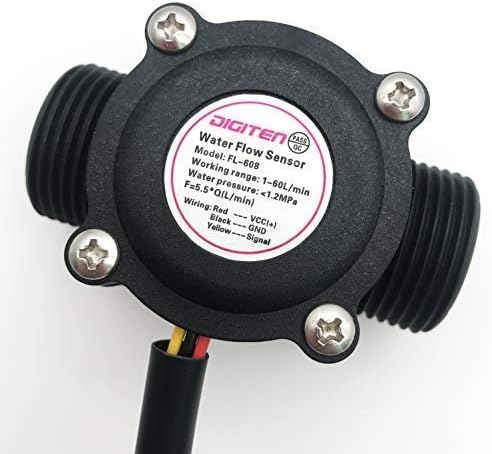
The 1/2 inch Flow Hall Sensor offers an affordable entry point for DIY flow monitoring projects. With a 4.7 rating and a flow range of 1 to 30 liters per minute it covers most home appliance needs. Its hall effect design ensures it stays dry and safe inside the water pipe.
We may earn a commission when you buy through this link, at no additional cost to you.
This sensor features an integrated magnetic hall effect sensor that outputs a pulse every revolution. The bearings used are nimble making the unit light and easy to install. You can use it in coffee machines or water purifiers without needing extra space.
Keep in mind that the unit must be installed in the correct flow direction to output a signal. If installed backwards there will be no output. This is a common trait in hall sensors but requires attention during setup.
Those seeking a cost effective solution for basic water testing should consider this pick. It is reliable for simple tasks like monitoring drinking fountain usage. We suggest checking the thread type carefully before ordering to match your pipes.
Its nimble outline and small size make it simple to fit into tight plumbing enclosures.
The sensor is sealed from the water pipe keeping electronics safe from moisture damage.
We may earn a commission when you buy through this link, at no additional cost to you.
The Taidacent YF-S201 Hall Effect Water Flow Sensor delivers premium performance with a perfect 5.0 user rating. It is designed specifically for water heater inlet detection providing accurate regulation of flow rates. The plastic valve body ensures durability while keeping the unit lightweight for easy integration.
We may earn a commission when you buy through this link, at no additional cost to you.
Inside the sensor a magnetic rotor rotates as water passes through the assembly. The Hall sensor outputs a corresponding pulse signal that feeds back to your controller. This feedback loop allows the system to regulate water flow dynamically for better efficiency.
Users report that the build quality holds up well against regular wear. However you must ensure the sensor is installed at the water inlet end for proper function. This specific placement is critical for the controller to determine water magnitude correctly.
If you are building a smart water heater or dispenser system this is a top choice. Its precise regulation capabilities help prevent overheating or waste. We recommend it for projects where accuracy and reliability are non-negotiable priorities.
The controller uses pulse feedback to adjust water magnitude and ensure safe system regulation.
Installed at the water inlet this model detects influent flow rate effectively.
We may earn a commission when you buy through this link, at no additional cost to you.
The DEVMO 1/2 inch Water Flow Hall Sensor achieves an impressive 4.9 rating from users. It supports high amplitude output of 4.6V ensuring clear signals for logic boards. Its design makes it suitable for water cooling systems and testing devices.
We may earn a commission when you buy through this link, at no additional cost to you.
This unit offers high electric strength rated at 1250V/min which adds safety against surges. The flow range of 1 to 30 liters per minute fits standard vending or credit card machines well. It is a solid option for specialized industrial testing needs.
Note that the electrical parameters require compatible boards to interpret correctly. If your Arduino uses pullups you may need to check voltage levels. This is a minor detail but impacts how you wire the sensor for reliable data.
Choose this model if you need strong voltage output for long cable runs. It is robust enough for cooling loops or beverage machines. We advise checking your controller input limits before installation.
High amplitude signals help maintain data integrity even over longer wire distances.
High electric strength rating protects the device from electrical stress in industrial settings.
We may earn a commission when you buy through this link, at no additional cost to you.
The 1/2 inch Water Flow Sensor offers a food grade build suitable for drinking water. With a working voltage of 5 to 24 volts it adapts to various power supplies. It supports a flow range of 1 to 30 liters per minute for home needs.
We may earn a commission when you buy through this link, at no additional cost to you.
All raw materials conform to ROHS testing standards ensuring safety for potable water use. It connects via a G1/2 inch BSPT male thread which is common in many fixtures. This makes it a standard choice for general water metering projects.
While it has a 4.1 rating it remains a reliable option for those prioritizing material safety. Just ensure your connections are tight to prevent leaks. This is a basic model that focuses on safe operation for daily use.
Select this unit for any project involving food or beverages. Its food grade plastic ensures no contaminants enter your supply. We recommend it for coffee machines or water dispensers in kitchens.
Raw materials meet ROHS standards ensuring safe water contact for daily use.
Supporting 5 to 24 volts allows connection to diverse microcontroller boards.
We may earn a commission when you buy through this link, at no additional cost to you.
The 2Pcs YF-S201C flow sensor pack offers a transparent body for visual flow inspection. It supports a voltage of 3.5 to 24 volts which is versatile for many projects. The impeller uses stainless steel beads for improved wear resistance over time.
We may earn a commission when you buy through this link, at no additional cost to you.
The valve body material is transparent to facilitate observation of water flow and rotor conditions. You can easily check if the sensor is spinning or stuck. This feature is rare and helpful for debugging flow issues.
Despite the visual benefit the rating is 3.7 which suggests quality variability. The two pack offers good value if one fails or for multiple sensors. Ensure you handle the transparent body gently to avoid cracking.
Opt for this model if visual confirmation of flow is important. It suits card readers or automatic water dispensers well. We suggest buying the two pack for extra safety in your build.
The transparent body allows you to see water flow and rotor status directly.
Stainless steel beads in the impeller improve wear resistance and longevity.
We may earn a commission when you buy through this link, at no additional cost to you.
The 1/4 inch Water Flow Sensor connects directly to a hosepipe with 5 to 7mm inner diameter. It supports a low flow range of 0.3 to 6 liters per minute. This makes it ideal for small irrigation or low volume projects.
We may earn a commission when you buy through this link, at no additional cost to you.
It uses food grade plastic materials safe for potable water use. The working voltage ranges from 5 to 24 volts allowing flexibility with power sources. Its small size is perfect for tight spaces where large sensors won't fit.
Pressure is limited to 0.8 Mpa which is lower than other models. Avoid high pressure lines to prevent leaks or damage. This constraint ensures you use it only on low flow safe systems.
Choose this for gardening or small water dispensers. Its hose connection removes the need for threads. We recommend it for prototypes using standard garden tubing.
Direct hosepipe connection simplifies setup without needing threaded adapters.
Ideal for low flow needs like drippers or small water systems.
We may earn a commission when you buy through this link, at no additional cost to you.
The DIGITEN G1/2 inch Water Flow Sensor comes with a 1.2 meter cable for flexible placement. It is compatible with Arduino and Reverse Osmosis filters. Its 4.8 rating reflects strong user satisfaction with reliability.
We may earn a commission when you buy through this link, at no additional cost to you.
The cable length allows you to mount the sensor far from the board. You get a SM2.54 3P wire connector type for easy hookup. This saves time on soldering and keeps wiring clean.
The material is potable water safe and pressure resistant. Connect to G1/2 BSPT threads using tape if adapting to NPT. The cable adds convenience but requires careful routing to avoid stress.
Select this model if you need to hide the sensor inside a cabinet. The cable makes it easy to reach your controller. We recommend it for integrated smart home water systems.
A 1.2 meter cable allows remote placement away from the main board.
Materials are ROHS tested and safe for water filtration and drinking systems.
We may earn a commission when you buy through this link, at no additional cost to you.
The DIGITEN G3/8 inch Water Flow Sensor offers a small thread for compact setups. It supports a flow range of 0.3 to 10 liters per minute. This makes it suitable for tight spaces or small water systems.
We may earn a commission when you buy through this link, at no additional cost to you.
It uses a Hall effect sensor outputting a square wave signal. The working voltage is 3.5 to 12 volts which works well with 5V boards. This model is easy to install and heat resistant for stable operation.
While the flow range is lower than others it is perfect for small lines. Ensure your pipes match the G3/8 thread size. This small size is a benefit for portable or low volume projects.
Choose this if space is a major constraint in your build. Its square wave output is compatible with most logic boards. We recommend it for reverse osmosis systems with limited room.
The G3/8 thread fits into tight spaces where standard G1/2 sensors won't fit.
Supports 3.5 to 12 volts making it compatible with battery or low power systems.
We may earn a commission when you buy through this link, at no additional cost to you.
The DIGITEN G3/4 inch Water Flow Sensor supports higher flow rates up to 60 liters per minute. It features a 1.2 meter cable for flexible sensor mounting. This model fits large G3/4 pipes which are common in main lines.
We may earn a commission when you buy through this link, at no additional cost to you.
Its materials are ROHS tested and safe for potable water. The hall effect sensor provides square wave output for accurate counting. It is waterproof and pressure resistant for durable operation.
Despite the high flow it has a 3.2 rating which suggests quality concerns. You must use thread seal tape when adapting to NPT. Ensure the cable is protected to avoid wear over time.
Select this for high volume applications like main water metering. The cable helps integrate it into control boxes. We recommend it for larger projects where flow speed is the priority.
Supports up to 60 liters per minute making it suitable for main water lines.
G3/4 thread fits larger pipes used in residential or commercial plumbing.
We may earn a commission when you buy through this link, at no additional cost to you.
Choosing the right flow meter depends on your specific project needs and plumbing setup. We examine the key factors to consider before buying.
The flow rate range determines the volume of water the sensor can measure accurately. Some models handle 1 to 30 liters per minute while others reach 150 liters per minute. Ensure your pick covers your min and max expected flow for accurate data.
Pick a model with enough range to avoid saturation or poor reading at low speeds.
The connection thread size must match your existing plumbing pipes. Common options include G1/2, G3/8, and G3/4 inches. Using a mismatched thread leads to leaks or the need for adapters.
Check your pipe size carefully before selecting a sensor to ensure a tight fit.
Arduino boards usually run at 5V but some sensors support 12V or 24V. Higher voltage may be needed for long cable runs or specific output requirements. Verify your microcontroller logic level compatibility.
Ensure the sensor voltage matches your board to avoid damage or signal issues.
If the sensor will be in a drinking water system check for ROHS or food grade certification. Plastic materials must be safe for potable water. Non safe materials may leach chemicals into your supply.
Choose certified food grade models for drinking or beverage machines.
Hall effect sensors output a square wave pulse for every rotation. This digital signal is easy for Arduino to count. Some sensors provide a switch output while others offer analog voltage.
Digital pulse output is best for precise flow measurement in Arduino projects.
Some models come with a cable while others require your own wiring. A long cable allows placing the sensor inside cabinets away from the board. Short cables might require soldering or extension.
Look for pre wired models if you want easier installation.
Every flow sensor has a maximum water pressure limit typically around 1.75 Mpa. Exceeding this limit can damage the internal bearings or seals. Ensure your water pressure stays within this safe range.
Check the pressure spec to avoid failure in high pressure lines.
Sensors must be installed in the correct flow direction. If installed backwards the hall sensor may not output any signal. Look for arrows on the body indicating flow direction.
Follow flow arrows to ensure the sensor reads correctly.
Install the sensor in the correct flow direction by aligning the arrow on the body with the water movement. Secure the threaded connection with Teflon tape to prevent leaks at the pipe interface. Avoid overtightening which may crack the plastic body.
Wire the sensor output to a digital pin on your Arduino board. Use a pull up resistor if needed to ensure clean pulse signals for reading. Connect the VCC and GND to the power supply matching voltage requirements.
Test the system with low pressure first to verify pulses before full pressure. Periodically check for sediment buildup that may block the rotor. Clean the valve body if flow drops over time.
An Arduino flow meter is a sensor that measures the volume of fluid moving through a pipe. It connects to an Arduino board to send digital pulses representing flow. This allows projects to track water usage or control valves.
For small home appliances like coffee machines choose 1 to 30 liters per minute. For industrial or main water lines consider 50 to 150 liters per minute. Match the range to your system demand to avoid saturation.
Only select models marked as food grade or ROHS compliant are safe for potable water. Non safe models may leach chemicals into your supply. Always check the materials list before installation.
Connect VCC to 5V and GND to ground. Wire the signal pin to a digital pin with interrupts. Use a resistor to pull up the signal if needed for clear pulse reading.
Yes but ensure pressure stays under 1.75 Mpa to prevent damage. Exceeding pressure limits risks cracking the valve body or sealing seals. Install a pressure regulator if needed.
Check flow direction and wiring connections first. Sediment may block the rotor so clean the valve body. Ensure voltage matches requirements and no shorts are present.
Accuracy varies by model but most fall within 2 to 3 percent error. Higher end models like G1.5 inch offer better stability. Calibration in software can improve precision for your needs.
These sensors are designed for water or similar fluids only. Oil or chemicals may damage internal parts or seals. Use a chemical compatible sensor for non water fluids.
This guide covered ten top flow sensors with different flow rates and thread sizes. Whether you need low flow for small projects or high flow for main lines there is a pick for you. Consider the TITEN G1.5 for performance and the 1/2 inch Hall for budget.
Prioritize flow range, thread size, and material safety when choosing a model. Ensure your project supports the voltage output and wiring options. A well matched sensor ensures reliable data and long term stability.
Prices and availability change so check current listings before purchasing. We suggest reviewing product specs to match your exact plumbing needs. Select the right sensor to complete your Arduino flow project confidently.