
ESP32-S3-Nano Microcontroller
5.0Editor score
Integrated 8MB PSRAM
Arduino and MicroPython Support
HID Emulation Capability
This guide compares the top Arduino Nano ESP32 boards for IoT projects, highlighting features like Wi-Fi, Bluetooth, and MicroPython support for makers.
The Arduino Nano ESP32 represents a significant leap in embedded development, combining powerful processing with wireless connectivity. These boards are essential for modern IoT projects requiring efficient data handling and seamless communication. Selecting the right model ensures your project runs smoothly from prototype to production.
We evaluated ten top-rated boards based on performance, connectivity, and ease of use. Our analysis covers microcontroller specs, power management, and software compatibility to help you find the ideal fit. Whether you need raw power or compact design, this list covers the leading options available today.
Each pick highlights unique strengths and potential trade-offs to guide your decision-making process. Detailed reviews break down features like USB-C support, memory capacity, and specific use cases. Remember that prices and availability can change, so check current listings before purchasing your next development board.
5.0Editor score

4.6Editor score

4.8Editor score
This side-by-side comparison highlights the key specifications and capabilities of the top ten Arduino Nano ESP32 boards. Use this table to quickly identify the best option for your specific project requirements and budget constraints.


The Arduino Nano ESP32 with Headers stands out as the premier choice for developers seeking a balance of power and connectivity. It features the ESP32-S3 microcontroller, offering robust processing capabilities for complex IoT applications. This board is designed to handle everything from voice recognition to machine learning at the edge.
We may earn a commission when you buy through this link, at no additional cost to you.
Its comprehensive wireless connectivity includes both Wi-Fi and Bluetooth 5.0, ensuring reliable communication across various networks. The USB-C port provides faster programming and stable power delivery, improving the development workflow significantly. Additionally, HID support allows for unique projects like custom keyboards or mice.
While the cost is slightly higher than generic alternatives, the official support and feature set justify the investment for serious projects. The integration of MicroPython makes it accessible to developers who prefer Python over C++. This flexibility speeds up prototyping and reduces development cycles for educational or commercial use.
Anyone building smart home systems or wearable tech will find this board ideal for its reliable connectivity and processing speed. The official Arduino ecosystem support ensures long-term viability for your projects. We recommend this as the top choice for most users entering the ESP32 ecosystem.
The dual Wi-Fi and Bluetooth 5.0 support enables seamless interaction with cloud platforms and mobile devices.
MicroPython compatibility allows for faster coding cycles and easier learning for beginners compared to C++.
We may earn a commission when you buy through this link, at no additional cost to you.
This ESP32-S3-Nano board offers exceptional value for makers looking to maximize memory without overspending. It comes with a massive 8MB PSRAM and 16MB Flash, allowing for complex applications that require significant data storage. The rating reflects high user satisfaction with its performance and reliability.
We may earn a commission when you buy through this link, at no additional cost to you.
The ability to seamlessly switch between Arduino and MicroPython makes it incredibly flexible for different project needs. Users can leverage the Arduino IoT Cloud to monitor and control projects remotely with ease. The HID feature further extends its utility for interactive input devices.
While it is a third-party board, the community feedback indicates reliable performance comparable to official models. The memory specs are particularly impressive for the price point, making it suitable for data-heavy tasks. It serves as an excellent entry point for those testing the ESP32-S3 capabilities.
Students and hobbyists on a tight budget should consider this board for its generous memory and wireless features. It provides all the essential tools needed for IoT development without the premium cost. We recommend it for cost-sensitive projects requiring high performance.
With 8MB PSRAM and 16MB Flash, this board handles larger datasets and more complex code than standard models.
Support for both Arduino and MicroPython allows developers to choose the language that fits their expertise best.
We may earn a commission when you buy through this link, at no additional cost to you.
The ESP32-P4-NANO is a premium board designed for developers who need advanced multimedia processing capabilities. It uses the RISC-V architecture with dual-core processors, offering high-speed performance for complex applications. The onboard MIPI interfaces support high-resolution displays and camera inputs directly.
We may earn a commission when you buy through this link, at no additional cost to you.
Its powerful image and voice processing capabilities make it ideal for smart displays or security systems. The hardware security features like Secure Boot and Flash Encryption protect sensitive data effectively. Additionally, the rich set of peripherals simplifies connections to external modules.
While the price is higher, the unique features justify the cost for professional or industrial applications. The complexity of setup may require more expertise compared to standard boards, but the performance gains are significant. This board pushes the boundaries of what is possible on a Nano form factor.
Advanced users building vision-based systems should choose this board for its specialized hardware support. It offers a robust foundation for projects that require real-time image processing. We consider it the best premium option for specialized IoT and embedded projects.
The MIPI-CSI and DSI interfaces allow direct connection to cameras and displays for rich visual applications.
Built-in cryptographic accelerators ensure that your data and boot processes remain secure from unauthorized access.
We may earn a commission when you buy through this link, at no additional cost to you.
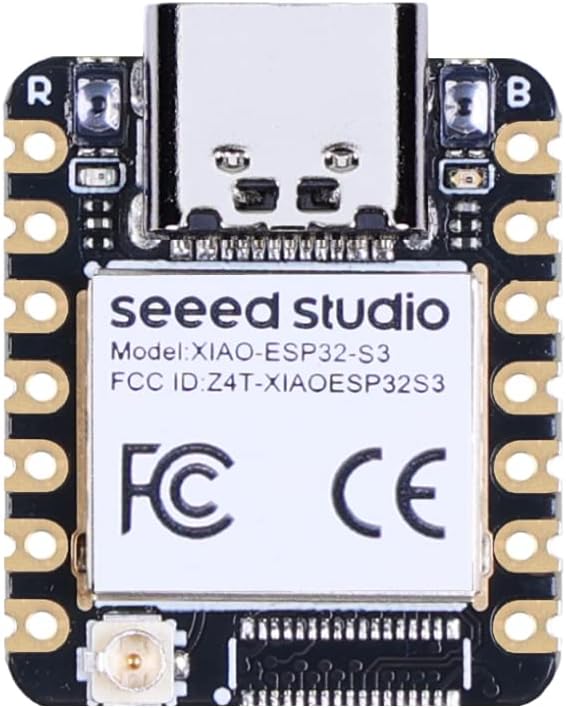
The Seeed Studio XIAO ESP32S3 is a thumb-sized board perfect for wearable devices and space-constrained projects. It integrates the powerful ESP32-S3 MCU into a tiny footprint without sacrificing wireless capabilities. Its design focuses heavily on power efficiency for battery-operated devices.
We may earn a commission when you buy through this link, at no additional cost to you.
With a low sleep current of 14μA, this board ensures long battery life for remote sensors. The lithium battery charge management capability simplifies power design for portable projects. The RF performance supports long-range communication when paired with an external antenna.
While the size is a strength, soldering headers can be challenging for those with limited experience. The number of GPIO pins is also lower compared to standard Nano boards. However, these trade-offs are acceptable for the portability it offers.
Developers working on wearables or robotics should consider this board for its efficient power design. It is perfect for projects where size and battery life are critical factors. We recommend it for compact and battery-powered applications.
The deep sleep mode allows the device to run for extended periods on small battery packs.
The tiny size makes it easy to embed into small devices without adding bulk.
We may earn a commission when you buy through this link, at no additional cost to you.
This Waveshare option provides a 3-pack of ESP32-S3 Mini boards, ideal for prototyping multiple units or classrooms. The ESP32-S3FH4R2 chip delivers consistent performance with a 240MHz frequency. Each board supports independent power supply settings for flexibility in deployment.
We may earn a commission when you buy through this link, at no additional cost to you.
The 2.4GHz Wi-Fi and BLE 5.0 ensure robust connectivity for various applications. Castellated module design allows these boards to be soldered directly onto carrier boards for custom PCBs. This makes them suitable for transitioning from prototype to production.
The price per unit is competitive due to the bulk packaging, offering great value for schools or batch production. However, documentation may be basic compared to official Arduino boards. Users should rely on community resources for deeper technical details.
Teams needing multiple boards for projects should find this pack cost-effective and reliable. It serves as a good option for testing different configurations without buying individual units. We recommend it for budget-conscious projects requiring multiple units.
Buying in a 3-pack reduces the cost per board significantly for larger project teams.
The module design facilitates easy soldering to custom boards for compact final products.
We may earn a commission when you buy through this link, at no additional cost to you.
The ELEGOO ESP-32 Super Starter Kit is a complete package designed for those new to embedded systems. It includes over 35 modules, giving you immediate access to a wide range of sensors and actuators. The board features a powerful dual-core processor suitable for IoT.
We may earn a commission when you buy through this link, at no additional cost to you.
Step-by-step online tutorials guide you through 30+ projects, making it easy to learn the fundamentals. The kit is fully compatible with the Arduino IDE, which simplifies the programming process for beginners. This comprehensive approach helps users build confidence quickly.
While it does not use the Nano ESP32-S3 chip, it is excellent for learning basic principles. The ESP-32 chip is well-documented and widely supported in community resources. This makes it a reliable choice for education and prototyping.
Students and hobbyists starting their journey will benefit greatly from the included components and guides. It removes the guesswork of selecting compatible parts for a project. We recommend this for those looking for an all-in-one learning solution.
The included tutorials provide structured learning paths from basic circuits to advanced IoT applications.
With 35+ modules, you can explore various sensors and displays without extra purchases.
We may earn a commission when you buy through this link, at no additional cost to you.
The Arduino Nano 33 IoT is designed with security as a priority, featuring a built-in Secure Element. This hardware ensures that data transmission and cloud communication are protected from unauthorized access. It is powered by an ARM Cortex-M0+ processor for efficient performance.
We may earn a commission when you buy through this link, at no additional cost to you.
Its connectivity relies on the u-blox NINA-W102 module, which supports Wi-Fi and BLE seamlessly. The board comes with pre-soldered headers, saving time during setup. This makes it ideal for secure IoT deployments in smart homes or industrial settings.
While it has less RAM than the newer ESP32 options, the security features often outweigh this for sensitive data. The integration is robust and well-tested by the Arduino team. Users can trust it for professional applications requiring high reliability.
Projects requiring data privacy should consider this board for its built-in encryption features. It offers peace of mind for IoT developers focused on security. We recommend it for secure wireless applications.
The Secure Element provides a trusted execution environment for managing keys and encryption.
Pre-soldered headers allow for immediate connection to breadboards without additional tools.
We may earn a commission when you buy through this link, at no additional cost to you.
This ESP-WROOM-32 board offers a reliable wireless core for various development needs. It supports dual-mode Wi-Fi and Bluetooth for versatile connectivity options. The onboard antenna and RF filter ensure stable communication in noisy environments.
We may earn a commission when you buy through this link, at no additional cost to you.
The board is compatible with the Arduino IDE, making it accessible for most developers. It supports multiple network modes such as AP, STA, and a combination of both. This flexibility allows it to act as a server or a client easily.
While it lacks the newest Bluetooth features, it remains a solid choice for basic IoT devices. The ultra-low power consumption helps extend battery life in remote deployments. It is often found in packs, reducing unit costs significantly.
General-purpose IoT projects can rely on this board for consistent performance. It is a workhorse for standard wireless applications. We recommend it for cost-effective connectivity solutions.
Support for AP and STA modes allows the board to host networks or connect to them.
The integrated filter and antenna optimize signal strength for better range.
We may earn a commission when you buy through this link, at no additional cost to you.
These ELEGOO boards bring a modern twist to the ESP-32 with a USB-C port for programming and power. This update aligns with current connector standards, making cable management easier. The boards support over-the-air updates for convenient firmware management.
We may earn a commission when you buy through this link, at no additional cost to you.
They feature dynamic clock scaling to reduce power consumption in battery-driven scenarios. The CP2102 USB chip ensures stable serial communication during uploads. This makes debugging and monitoring more straightforward than older serial-to-USB bridges.
The 3-pack is a convenient option for teams needing spares or for testing multiple devices. While the Bluetooth is older, the core processing remains robust. Users appreciate the reliability and quality of the components used.
Projects requiring modern connectivity should favor these boards for their USB-C support. The OTA feature is a strong asset for deployed devices. We recommend it for developers valuing modern interfaces.
The USB-C port ensures forward compatibility with newer cables and power sources.
OTA support allows updating devices remotely without physical access to the board.
We may earn a commission when you buy through this link, at no additional cost to you.
The Arduino UNO R4 WiFi combines dual-core processing with unique features like a built-in LED matrix. It offers powerful connectivity through Wi-Fi and Bluetooth 5.0, ensuring stable communication. The board also includes advanced analog capabilities like a 12-bit DAC.
We may earn a commission when you buy through this link, at no additional cost to you.
CAN support makes it suitable for automotive or industrial applications. The Qwiic connectors simplify I2C sensor integration, reducing wiring complexity. These features make it a versatile choice for projects needing both power and specific interfaces.
While larger and pricier, the added functionality reduces the need for external breakout boards. The LED matrix provides immediate visual feedback for interactive projects. This level of integration saves time during prototyping.
Complex projects needing specialized interfaces should choose this board for its comprehensive feature set. It is excellent for advanced prototyping. We recommend it for feature-rich development needs.
The 12×8 LED matrix allows for direct display without external components.
CAN support and Qwiic connectors simplify connections for robust real-world systems.
We may earn a commission when you buy through this link, at no additional cost to you.
Choosing the right board requires understanding your specific project needs and technical requirements.
The core processor determines the speed and efficiency of your project. The ESP32-S3 offers dual-core performance with AI accelerators, making it ideal for voice and machine learning tasks. RISC-V options like the P4 provide alternative architectures for specialized needs.
Always match the processor power to your application complexity to avoid overpaying or underperforming.
Wi-Fi and Bluetooth versions vary across models. Modern Bluetooth 5.0 offers better range and stability than older 4.2 versions. Ensure the board supports the specific protocols your devices rely on.
Select boards with the latest connectivity standards to ensure long-term compatibility and robust performance.
RAM and Flash memory dictate how much code and data you can store. Applications with heavy data or complex graphics need higher PSRAM. Most boards offer at least 8MB Flash, but check if you need more.
Verify memory specs before starting data-intensive projects to prevent storage limitations during development.
Power efficiency is critical for battery-operated devices. Look for deep sleep modes and battery charge support if portability is a goal. Some boards offer dedicated power modes for minimal energy use.
Prioritize low-power features if your device needs to run for months on a single battery charge.
USB-C is becoming the standard for modern boards, offering easier connection and better power delivery. Older micro-USB ports are less convenient. A robust connector improves the physical durability of your setup.
Choose a board with a USB-C port for better longevity and ease of use during testing.
Compatibility with Arduino IDE or MicroPython affects your development speed. Official boards often have better documentation and support. Third-party boards may require specific drivers or configurations.
Stick to well-supported boards if you plan to use community libraries or frameworks extensively.
The physical size matters for wearable or space-constrained projects. Nano variants offer compact designs that fit into small enclosures. Standard sizes provide more space for headers and testing.
Ensure the board dimensions align with your enclosure design to avoid mechanical issues later.
For commercial applications, hardware security is a major factor. Look for secure elements or boot encryption to protect data. These features are often found on higher-end boards like the Arduino 33 IoT.
Implement hardware security if your project involves sensitive data or critical infrastructure.
To begin using your board, install the necessary drivers and IDE software on your computer. Connect the board via USB-C to ensure stable power during uploads. Most modern IDEs automatically detect the device once connected.
When designing your circuits, use breadboards to test connections before soldering. This helps avoid short circuits that could damage the sensitive microcontroller components. Always check power levels before connecting external modules.
Store your board in a dry place away from static electricity. If you are using it for portable projects, ensure the battery is securely mounted. Regularly update your firmware to maintain security and performance.
Yes, the Arduino Nano ESP32 is compatible with recent versions of the Arduino IDE. You may need to add the board manager URL to access the specific ESP32-S3 package. Most libraries are supported, but ensure your board version is up to date for the best experience.
Many of the reviewed boards support MicroPython for easier programming. The official Arduino Nano ESP32 and several third-party models allow switching between Arduino and MicroPython. Check the specific product description for language compatibility details.
The ESP32-S3 focuses on Wi-Fi and BLE connectivity with AI accelerators, suitable for general IoT. The ESP32-P4 prioritizes multimedia processing with RISC-V cores and MIPI interfaces. Choose based on whether you need connectivity or image processing.
Yes, many boards support battery charging and low-power modes. Features like deep sleep help extend battery life significantly. Look for boards with integrated charge management for portable projects.
Firmware updates are typically done via USB using the Arduino IDE or specialized flashing tools. Some boards support Over-the-Air updates, allowing remote upgrades. Ensure your computer recognizes the device before flashing.
Most Nano boards follow standard pin layouts, but shield compatibility can vary. Check the pinout of your specific board to ensure matches with your shield. Some compact models like XIAO have unique pin arrangements.
We have reviewed ten top options ranging from budget-friendly to high-performance boards. The official Nano ESP32 leads for those seeking reliability, while budget options like the ESP32-S3-Nano offer great value.
When selecting a board, prioritize features that match your specific project goals. Connectivity, power, and memory are the key factors to evaluate before purchasing to ensure success.
Always check current prices and availability as these details may change over time. We hope this guide helps you find the perfect board for your next embedded development adventure.