
HiLetgo 5pcs DHT11
4.5Editor score
Single wire digital output
20 to 95 percent humidity range
Simple communication protocol
This guide compares the top Arduino temperature sensor options available in October 2026 to help you choose the right device for your project needs.
Finding the right Arduino temperature sensor is crucial for any project requiring precise environmental monitoring. Whether you are building a smart home device or an industrial monitoring system, the correct sensor ensures reliable data collection and stable performance over time.
We have carefully evaluated ten leading sensor modules based on accuracy, ease of integration, and overall reliability. Our comparison covers a range of options including digital humidity combos and waterproof probes suitable for diverse applications across different voltage requirements.
Each pick below highlights specific strengths and ideal use cases to help you narrow down your choice quickly. Please note that product availability and pricing can change frequently so always check the current listings before making your final purchase decision today.
4.5Editor score

4.9Editor score

4.7Editor score
The following table provides a side by side comparison of all ten selected sensors to help you quickly identify the best fit for your specific voltage range accuracy requirements and environmental conditions.




The HiLetgo DHT11 module stands out as an accessible entry point for anyone beginning to measure environmental conditions with an Arduino. It comes with a digital output and integrates easily with common microcontroller boards without requiring complex signal conditioning circuitry.
We may earn a commission when you buy through this link, at no additional cost to you.
Its single wire communication protocol significantly reduces the programming effort needed to get started. Users can connect the sensor using just three pins and rely on well documented open source libraries to read temperature and humidity data reliably.
While the measurement accuracy is moderate and the range is limited to common indoor environments it delivers consistent results for hobbyist projects. The included bypass capacitor and pull-up resistor on the board ensure stable operation without extra components.
This sensor is ideal for students or makers needing multiple units at a low cost. If your project only requires basic indoor monitoring and you need five units for a group class this pack provides excellent value.
The simplified wiring scheme allows you to connect directly to a microcontroller IO port with minimal setup time.
Factory calibration ensures that the output is reliable right out of the box without additional user adjustments.
We may earn a commission when you buy through this link, at no additional cost to you.
The AHT30 module offers superior precision compared to many other options in its class. Its upgraded version design ensures stable readings even when connected to multiple I2C electronic devices on the same bus simultaneously.
We may earn a commission when you buy through this link, at no additional cost to you.
With a temperature accuracy of plus or minus zero point three degrees the sensor is suitable for projects requiring tight control. The low power consumption and simple circuit design make it efficient for battery powered applications.
The four pin test line connection allows for quick setup and users can access a wide voltage range from two volts to five volts. This flexibility simplifies power supply requirements in mixed voltage systems.
Choose this sensor when you need high resolution humidity and temperature data. Its fast transmission speed ensures that you can sample frequently without overwhelming your microcontroller or delaying other operations.
The sensor delivers accurate readings that are essential for scientific or industrial applications requiring tight tolerances.
Simultaneous online access to multiple I2C devices allows for scalable system designs without additional wiring complexity.
We may earn a commission when you buy through this link, at no additional cost to you.
The SHT31-D module brings industrial grade performance to hobbyist projects with its extensive temperature range and high accuracy. It supports a wide voltage input which makes it versatile for different power sources.
We may earn a commission when you buy through this link, at no additional cost to you.
Temperature accuracy is maintained within zero point three degrees across a range spanning from negative forty to one hundred twenty five degrees Celsius. This robustness ensures reliable data even in harsh environments.
Humidity measurement is equally precise with an accuracy of plus or minus two percent RH. The I2C interface allows for easy integration into existing bus systems without occupying multiple IO pins.
Ideal for demanding applications where reliability is critical this sensor justifies its cost through performance. The three pack provides spare units for prototyping or multi zone monitoring setups.
The extensive temperature range allows use in environments from freezers to industrial ovens without sensor damage.
Digital I2C output ensures noise immune communication and long term stability of readings over time.
We may earn a commission when you buy through this link, at no additional cost to you.
This waterproof probe is designed for use in wet environments where moisture resistance is essential. The adapter module simplifies connection to microcontrollers by integrating necessary pull-up resistors on board.
We may earn a commission when you buy through this link, at no additional cost to you.
The measuring range spans from negative fifty five to one hundred twenty five degrees Celsius making it suitable for extreme conditions. Lead construction handles submersion effectively for monitoring tanks or outdoor setups.
Plug and play capability reduces setup time significantly. The leads are color coded for quick identification and connection to power and data pins without confusion.
Best for applications like fish tanks or greenhouses this sensor delivers consistent performance. Ensure you respect the maximum temperature limit of the lead to maintain durability.
The waterproof enclosure ensures that internal electronics remain dry even when fully submerged in water.
The adapter includes a pull-up resistor which removes the need for external components during connection.
We may earn a commission when you buy through this link, at no additional cost to you.
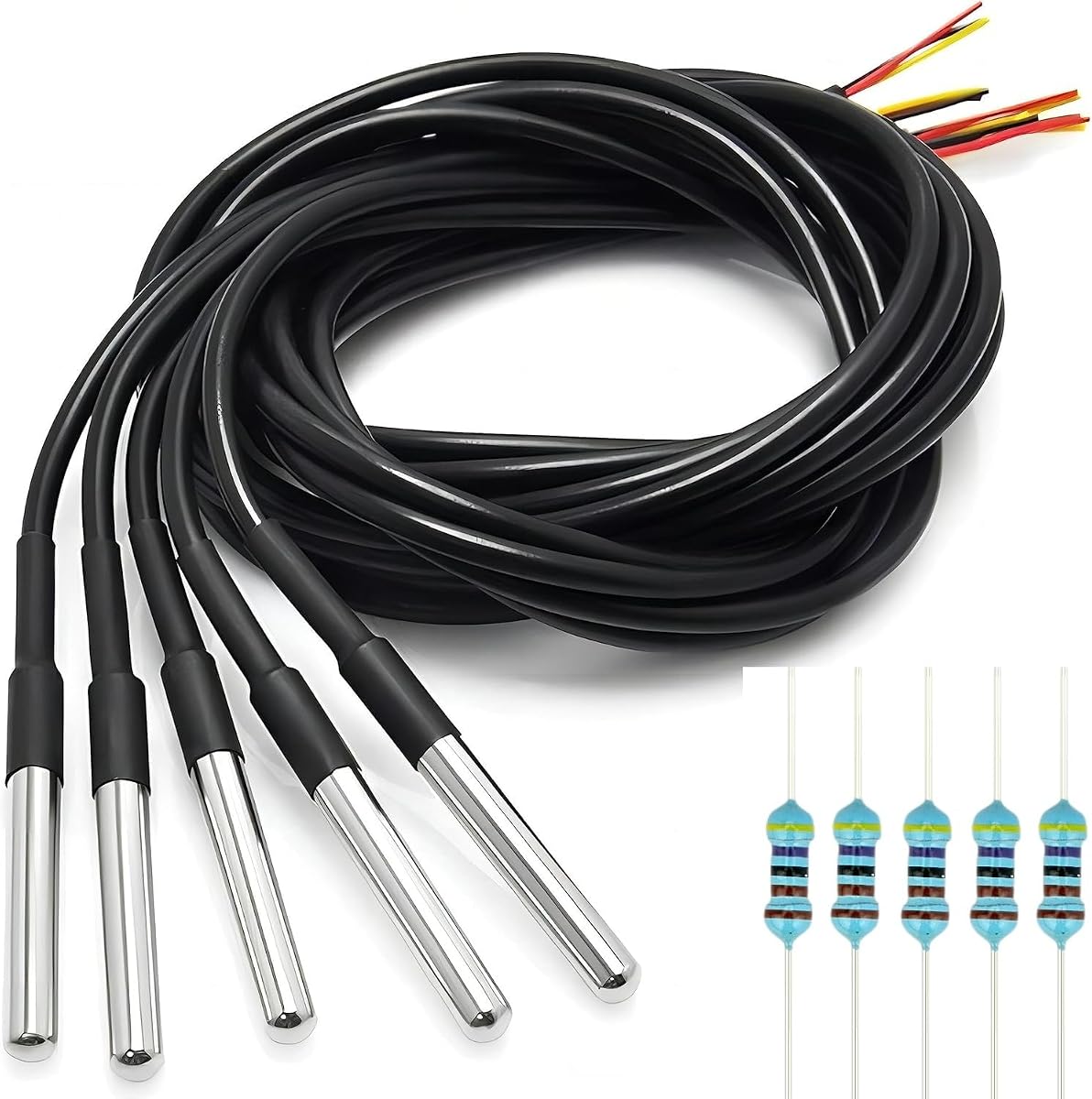
This pack offers five waterproof probes which is excellent for projects requiring multiple sensing points. The high accuracy rating ensures that data collected is reliable for critical monitoring tasks.
We may earn a commission when you buy through this link, at no additional cost to you.
The sensor operates effectively in wet environments without risk of damage from water exposure. Its wide voltage range allows it to work with various microcontrollers including Raspberry Pi and ESP32.
Five resistors are included to support the one wire interface configuration. This eliminates the need to source additional components when assembling your circuit.
Ideal for DIY projects needing bulk sensors this kit saves time and cost. Just ensure you have the necessary jumper wires to connect the probes to your board.
Getting five units in one package allows you to monitor multiple zones simultaneously without additional ordering.
Included 4.7K resistors simplify the assembly process by providing essential components for stable data lines.
We may earn a commission when you buy through this link, at no additional cost to you.
The DHT11 is a classic sensor known for its simplicity and ease of use. It provides calibrated digital outputs that combine temperature and humidity into a single data stream.
We may earn a commission when you buy through this link, at no additional cost to you.
Its internal microcontroller ensures reliable operation with excellent long term stability. The single wire scheme makes it easy to integrate into tight spaces on a breadboard.
Accuracy is suitable for general monitoring tasks where extreme precision is not required. The error margins are acceptable for most indoor climate control applications.
If you need just two sensors for a small setup this pack is a solid choice. It is particularly useful for beginners learning how to read environmental data.
The small footprint allows installation in confined spaces without obstructing other components.
Built in signal processing maintains consistent output even during minor voltage fluctuations.
We may earn a commission when you buy through this link, at no additional cost to you.
This complete kit includes everything needed for immediate deployment. The adapter boards simplify connections and the included jumper wires help you get started right away.
We may earn a commission when you buy through this link, at no additional cost to you.
The stainless steel probe is highly resistant to corrosion ensuring durability in harsh conditions. Heat shrink tubing on the wires provides additional protection against physical damage.
Operating on a wide voltage range ensures compatibility with most development boards. The robust one wire protocol reduces the complexity of the data transmission.
Choose this option if you want a ready to use solution. The comprehensive packaging means fewer trips to the parts store and faster project completion.
The stainless steel casing prevents rust even when exposed to moisture over long periods.
Accessories included in the box mean you can begin wiring and coding immediately without buying extras.
We may earn a commission when you buy through this link, at no additional cost to you.
With one meter leads this pack allows you to place sensors far from the main controller. This is particularly useful for monitoring large tanks or outdoor environments.
We may earn a commission when you buy through this link, at no additional cost to you.
The waterproof construction ensures that the sensor can withstand harsh conditions. The digital thermal probe delivers accurate data for a thermally sensitive system.
A single bus interface simplifies the cabling requirements significantly. This makes it easier to manage multiple sensors on a single GPIO pin.
Ideal for industrial or consumer products requiring long reach sensing this kit provides the necessary range. You will need to add resistors manually to stabilize the signal.
The one meter lead length allows flexible placement away from heat sources or power boards.
Designed for sensitive systems the probe responds quickly to temperature changes for timely alerts.
We may earn a commission when you buy through this link, at no additional cost to you.
The DHT22 module offers improved accuracy over its predecessor with a wider temperature and humidity range. It uses a high sensitive chip to ensure reliable combined sensor technology.
We may earn a commission when you buy through this link, at no additional cost to you.
Fixing screw holes allow for secure installation which reduces vibration induced errors. The single bus digital signal is bidirectional allowing for flexible communication protocols.
Humidity range covers zero to one hundred percent which is essential for full climate monitoring. The temperature accuracy is precise enough for many professional applications.
Recommended for practice projects needing better performance than DHT11. The mounting features make it easier to integrate into enclosures permanently.
Built in screw holes allow you to fasten the module securely to a wall or panel.
The humidity range covers the full spectrum from dry to fully saturated air accurately.
We may earn a commission when you buy through this link, at no additional cost to you.
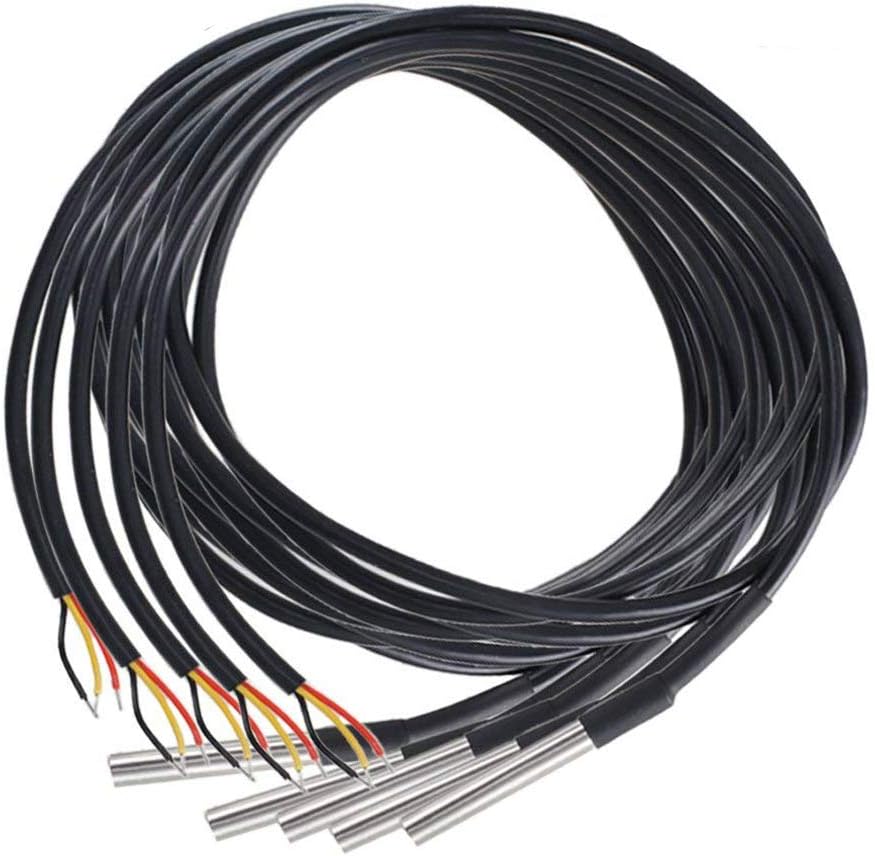
This pack provides five stainless steel probes which are highly durable and corrosion resistant. The waterproof design allows for submersion in various liquids without damage.
We may earn a commission when you buy through this link, at no additional cost to you.
The wide temperature range supports demanding applications from freezing to boiling. The cable length offers flexibility in sensor placement relative to the controller.
Simple single bus interface reduces wiring complexity significantly. However you will need to source resistors separately for stable operation.
Best for bulk projects where cost efficiency is key. The durability of the probe ensures long term service in harsh environments.
Stainless steel construction resists rust and corrosion ensuring long term reliability.
The single bus design simplifies the wiring needed for multiple sensors on one line.
We may earn a commission when you buy through this link, at no additional cost to you.
Selecting the right sensor involves balancing accuracy, range, and ease of use for your specific application.
Accuracy is critical for scientific or industrial applications. Look for sensors with tight tolerances like plus or minus zero point three degrees Celsius.
Choose high accuracy models if you need precise control over temperature thresholds.
Ensure the sensor supports the temperature range of your environment. Some modules only work indoors while others handle extreme cold or heat.
Select a range that exceeds your expected minimum and maximum values for safety.
Digital interfaces like I2C and single wire simplify connections. Analog sensors require ADC inputs which may be limited on some boards.
Pick an interface that matches your available GPIO pins and library support.
If your project involves liquids or outdoor exposure waterproof probes are essential. Stainless steel enclosures offer better durability than plastic ones.
Verify the IP rating or waterproof claims before placing sensors in wet areas.
Check if the sensor works with your board voltage such as three point three or five volts. Some modules have wide voltage ranges for flexibility.
Avoid using sensors outside their specified voltage range to prevent damage.
Some modules include holes for screws while others rely on adhesive or clips. Proper mounting ensures the sensor reads ambient air rather than board heat.
Consider how you will secure the sensor in your final enclosure.
Popular sensors often have extensive community libraries that simplify coding. This reduces the effort needed to read data and calibrate readings.
Opt for models with established open source libraries for easier development.
Bulk packs can lower the per unit cost significantly for large projects. Compare the included accessories like resistors or wires when evaluating price.
Balance the initial cost against the total value provided by the bundle.
Connect the power and data lines according to the module instructions ensuring correct polarity. Use a pull-up resistor if the sensor does not have one built-in for stable signals.
Install the appropriate library in your development environment to read values. Initialize the sensor in your setup loop and request data in your main loop.
Protect the sensor from direct heat sources to ensure it reads the ambient air temperature. Check connections periodically to maintain signal integrity over time.
The AHT30 and SHT31-D models offer high accuracy within zero point three degrees. These are ideal for applications requiring tight tolerance control.
Yes waterproof sensors can be used indoors but they are generally more expensive. They are beneficial if you need to mount them in moist rooms.
Most digital sensors like the DS18B20 require a pull-up resistor. Some kits include it but verify the datasheet for specific requirements.
Cable lengths vary by model with many coming at one meter. Longer leads allow you to place sensors away from the electronics heat.
Most modules operate between three point three and five volts. Check the supply range to match your power source correctly.
One wire and I2C sensors allow multiple units on a single bus. Ensure you have unique addresses or use the same library for multi-reads.
The DHT11 offers budget value while the DROK DS18B20 kit provides complete convenience for beginners. The SHT31-D stands out for premium performance in demanding environments.
Prioritize accuracy and waterproofing based on your project needs to ensure reliable long term operation. Avoid choosing based solely on price if it compromises essential features.
Always verify the current specifications and prices before purchase to match your latest requirements. Your sensor choice will define the quality of data you collect for your project.