
Sntieecr STEM Electric Circuit Motor Kit
4.2Editor score
Affordable entry level kit
Includes motors and bulbs
Simple circuit building
This guide compares the top 10 electricity learning kits for students and hobbyists to find the best options for hands-on STEM education and circuit building.
Electricity learning kits provide an engaging way for students to explore the fundamental principles of electrical circuits and magnetism through hands-on experimentation.
We evaluated ten top-rated kits based on component quality, project variety, instructional clarity, and suitability for different age groups and skill levels.
Each pick highlights key features and learning outcomes, helping you choose the right kit for your needs while noting that prices may change over time.
4.2Editor score

4.7Editor score

4.5Editor score
The following table offers a side-by-side overview of all ten kits including their primary focus, number of items, and target age range to help you decide quickly.



This kit stands out with over 120 projects allowing kids to explore electricity through diverse activities like light shows and sound systems.
We may earn a commission when you buy through this link, at no additional cost to you.
The components are designed for safety with easy snap connections that eliminate the need for tools ensuring a frustration free experience for young learners.
While the price is higher than basic kits the volume of activities and educational value justify the investment for serious budding engineers.
Ideal for curious kids aged 8 and up this kit provides hours of engagement while teaching core electrical engineering concepts effectively.
With over 120 projects kids can explore everything from fruit batteries to copter flying keeping them engaged for long periods.
Snap wires ensure secure connections without tools making it safe and easy for children to build complex circuits independently.
We may earn a commission when you buy through this link, at no additional cost to you.
This kit offers an entry level introduction to circuits with a focus on motors and bulbs at a very accessible price point.
We may earn a commission when you buy through this link, at no additional cost to you.
It includes essential components like crocodile clips and battery holders allowing students to build simple circuits and observe electrical flow easily.
Users should note the voltage limits as excessive use can cause heat so sessions should be kept short to ensure safety.
Best for younger students or those on a tight budget this kit provides a practical start to understanding electrical engineering basics.
Priced under fifteen dollars it provides a low risk way for families to introduce STEM concepts without a large financial commitment.
Unlike many kits this one emphasizes motors allowing kids to see how electricity converts into mechanical motion quickly.
We may earn a commission when you buy through this link, at no additional cost to you.
This kit is tailored for high school students offering a deeper dive into electricity and magnetism principles suitable for advanced coursework.
We may earn a commission when you buy through this link, at no additional cost to you.
It includes unique items like repair tools and a comprehensive manual that guides students through understanding the theory behind the experiments.
The focus on electromagnetism and advanced experiments makes it a premium choice for serious learners aiming for a robust physics foundation.
Ideal for grades 9 to 11 this kit bridges the gap between classroom theory and practical application effectively.
Students can explore complex concepts like Oersted experiments and Ampere's force investigation which are rare in standard kits.
The full color manual provides clear diagrams and explanations helping students connect physical builds with theoretical principles.
We may earn a commission when you buy through this link, at no additional cost to you.
This kit focuses on fundamental circuit concepts with a variety of fun experiments including fruit battery generation to engage kids.
We may earn a commission when you buy through this link, at no additional cost to you.
It comes with a detailed circuit book that offers guided learning ensuring students understand the principles behind each connection.
While the project count is lower than others the quality of instruction is strong promoting critical thinking and creativity.
Suitable for ages 8 to 14 it is a solid choice for parents looking to teach basic electrical engineering concepts at home.
Teaching kids to generate power from fruits helps visualize energy conversion and chemical reactions in a memorable way.
The detailed book supports independent study allowing children to progress at their own pace with confidence.
We may earn a commission when you buy through this link, at no additional cost to you.
This kit provides a hands-on introduction to electricity and magnetism with over 50 experiments designed to teach physics concepts.
We may earn a commission when you buy through this link, at no additional cost to you.
It includes a solid storage case which keeps all 55 items organized and ready for use in or outside the classroom.
Features like the Joule's first law experiment module offer unique learning opportunities that deepen understanding of heat in circuits.
Great for students looking to explore physics beyond basic circuits this kit offers a balanced approach to STEM learning.
Modules like magnetic switches and Joule law experiments provide a deeper look into how electrical energy interacts with matter.
The dedicated case makes it easy to transport components for group activities or science fairs without losing parts.
We may earn a commission when you buy through this link, at no additional cost to you.
This kit is designed for family discovery with components like a voltmeter that allow kids to measure electrical properties directly.
We may earn a commission when you buy through this link, at no additional cost to you.
It includes 18 hands-on experiments covering a wide range of concepts from fruit batteries to electric bells ensuring varied learning.
The materials are durable and the layout encourages parent-child interaction which can be valuable for guided learning experiences.
Suitable for ages 8 and up this kit is a strong option for families wanting to explore science together as a team.
Having a voltmeter allows kids to quantify their experiments adding a layer of realism to their electrical investigations.
The kit encourages shared activities making it an excellent tool for parents to engage with their children's education.
We may earn a commission when you buy through this link, at no additional cost to you.
This kit is tailored for high school students providing a robust set of experiments that cover both electricity and magnetism principles.
We may earn a commission when you buy through this link, at no additional cost to you.
It features unique items like a sensitive ammeter and magnetically controlled switch which add depth to the learning experience.
The double layer storage box ensures organization making it convenient for students to manage their components during experiments.
Best for grades 7 to 11 this kit helps students grasp complex concepts through structured and meaningful hands-on activities.
Including a sensitive ammeter teaches students how to measure current accurately which is a key skill in physics.
The inclusion of magnetism components allows for a more holistic view of how electricity and magnetic fields interact.
We may earn a commission when you buy through this link, at no additional cost to you.
This basic kit focuses on consolidating textbook knowledge with practical builds of series and parallel circuits for younger students.
We may earn a commission when you buy through this link, at no additional cost to you.
It comes with English instructions which makes assembly straightforward for students who may not have extensive prior experience.
The plastic storage box keeps components organized and the price point makes it accessible for schools or individual learners.
Ideal for grades 7 to 9 this kit is a great way to introduce foundational electrical rules without overwhelming complexity.
Building both series and parallel circuits helps students visualize current paths and resistance differences clearly.
The simplicity of the kit allows kids to master the basics before moving on to more advanced components.
We may earn a commission when you buy through this link, at no additional cost to you.
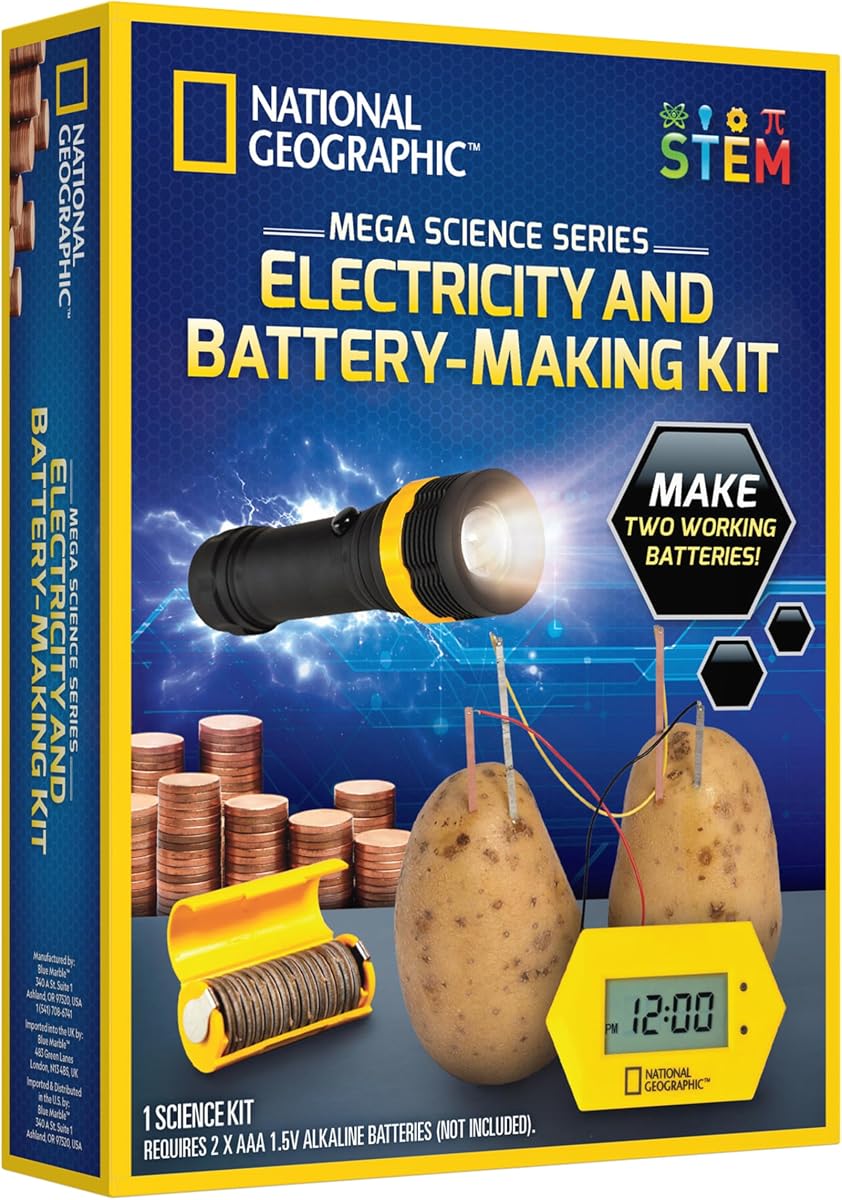
This kit offers a focused look at battery generation with a potato clock and a coin powered flashlight project.
We may earn a commission when you buy through this link, at no additional cost to you.
It includes a detailed learning guide that explains the science of chemical reactions in circuits helping kids understand why it works.
While it has fewer projects the novelty of building a battery from household items makes it a memorable and engaging experience.
Perfect for younger kids or short science sessions this kit provides a fun and educational introduction to how batteries function.
Making a potato clock teaches kids about electrochemical cells using organic matter in a way that is both fun and educational.
The guide provides fascinating insights into the science ensuring the activity is educational not just a craft.
We may earn a commission when you buy through this link, at no additional cost to you.
This upgrade kit expands on the basic offering with projects like a traffic light and wind power car to increase engagement.
We may earn a commission when you buy through this link, at no additional cost to you.
The transparent storage box allows for easy organization and quick identification of components making it ideal for classroom use.
It covers grades 7 to 11 and includes essentials like switches and wires to build more complex circuits easily.
Best for teachers or parents looking to extend learning the upgrade kit offers more project variety than the standard basic version.
Building a traffic light introduces parallel circuits and sequential switching which are valuable real world applications.
The clear box helps keep track of parts quickly ensuring lessons are not delayed by missing components.
We may earn a commission when you buy through this link, at no additional cost to you.
Choosing the right electricity learning kit requires considering the child's age, skill level, and specific educational goals to ensure a rewarding experience.
Kits are designed for specific age groups ranging from simple snap connections for young children to complex circuit boards for older students.
Always check the recommended age range to ensure the components are safe and the concepts are not too difficult or too easy.
Look for kits that offer a wide range of projects such as motor builds, light shows, or battery generation to maintain interest.
More projects usually mean more opportunities to reinforce learning and keep the experience fresh over time.
Durable wires, secure switches, and robust batteries ensure the kit withstands repeated use without breaking or causing frustration.
High-quality components lead to more reliable experiments which helps build confidence in the learner's ability to build circuits.
Clear manuals with diagrams or video support are crucial for guiding students through complex builds independently.
Instructions that explain the why behind the what help deepen understanding of the underlying physics concepts.
Safety features like low voltage limits, secure connections, and non-toxic materials protect children from heat or electric shock.
Always ensure the kit includes warnings and usage guidelines to supervise experiments appropriately especially with batteries.
Kits with organized cases or boxes help keep small parts safe and make setup and cleanup much easier.
Good storage prevents losing components which can render the kit unusable or frustrating over time.
Some kits focus on basic circuits while others delve into advanced topics like electromagnetism or energy conversion.
Choose a kit that aligns with school curriculum or specific interests like robotics or renewable energy to maximize value.
Prices vary widely so consider how many projects and components you get for the cost before purchasing.
A higher initial cost may be justified if it offers more longevity and educational depth than a cheaper option.
Start by reviewing the manual to understand the tools and components included before building any circuits.
Connect wires and parts as instructed and use the provided storage case to keep small items organized after each session.
Always use the recommended batteries and remove them when not in use to prevent leakage or damage to components.
Yes, most kits are designed with safety features like low voltage and snap connections. However, always check the age recommendation and supervise younger children.
Most kits do not include batteries so you will need to purchase AA or AAA batteries separately before starting experiments.
The best age depends on the kit but most are suitable for children aged 8 to 14 with some advanced options for high schoolers.
Projects range from 15 minutes to an hour depending on complexity. Simple circuits take less time than advanced projects.
Yes, many kits are designed for classroom use with storage cases and durable components suitable for group learning.
They differ in project variety component quality and complexity. Some focus on basics while others cover advanced physics topics.
Most kits come with storage boxes or bags. Organize parts by type after each use to prevent loss and make setup easier.
Replacement parts may be available from the manufacturer or third-party sellers depending on the kit brand and model.
The National Geographic Circuit Kit leads our list with its extensive project variety and kid friendly snap connections.
For budget conscious buyers the Sntieecr Motor Kit offers a simple but effective introduction to electrical engineering concepts.
Remember to check current prices and availability as these can change frequently across different retailers.